David Gerber
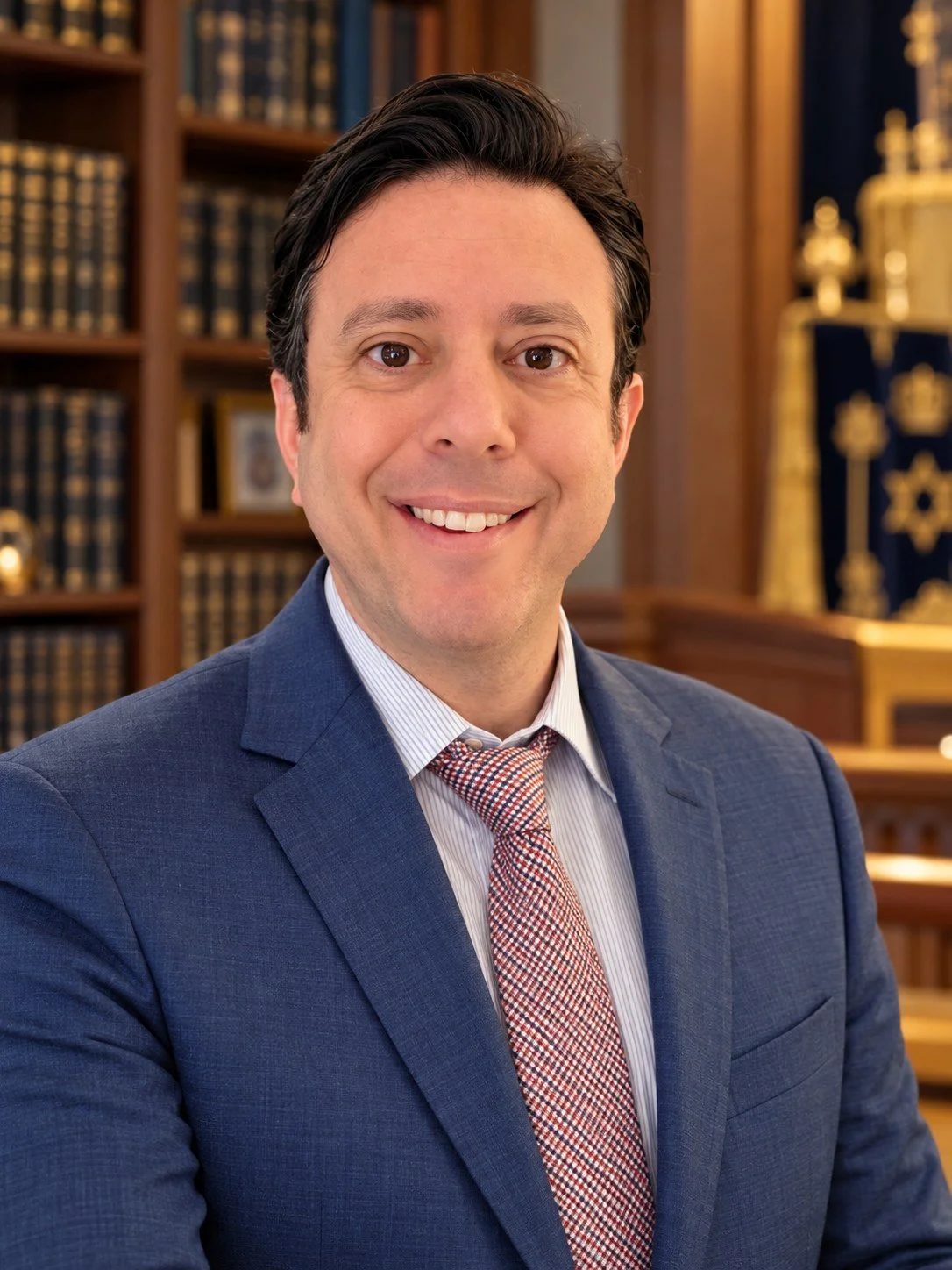
A Judaism grounded in God, Torah, and Israel, and built to show up for one another.
For 15 years I've served as a rabbi, building congregations, launching programs, raising millions, and writing for Jews across the denominational spectrum. Today I'm Senior Rabbi of Congregation Gates of Prayer in Metairie, home to more than 450 families.
I grew up in St. Louis, was ordained at Hebrew Union College, and served in suburban Philadelphia before coming to New Orleans. Here you'll find my resume, my teaching materials, and the writing I share each week.
Resume
- Spiritual, pastoral, and educational leader for 450+ member families
- Grew the religious school from 45 to 110 students by helping develop J-FLEx (Jewish Fun Learning Experiences), a hands-on, camp-style model of Jewish education, and Stepping Stones and Munchkin Minyan for young families
- Raised over $10M against a $6M goal and led a $3M campus expansion from vision to completion
- Founded The Fried Center, which brings congregations and students to New Orleans to learn about Southern Jewry, assists in disaster recovery, and runs the congregation's social action initiatives
- Founded GatesFest, the Voices of Zion speaker series, and Go Camp, which has doubled the number of our kids attending Jewish summer camp
- Serves as rabbi and advisor to the Jewish Community Day School, leading Torah study and Shabbat each month
- Directs AJC Leaders for Tomorrow
- President, Wissahickon Interfaith Community Association
- Presented at the 2015 URJ Biennial on retaining students and engaging youth
- Created Rosh Chodesh and Rosh Brodesh, post-b'nei mitzvah programs for teens
- Improved post-b'nei mitzvah retention from 25% to 80%
- Officiated three b'nei mitzvah a week, more than 100 a year
- Ran Walking the Walk, bringing Jewish, Christian, and Muslim teens together to learn their shared values
- Created Torah and Tunes and Hebrews and Hoops, pairing Torah study with guitar lessons and basketball
- Taught the Maimonides program at University of Pennsylvania Hillel
- Launched Jewish Professionals of Suburban Philadelphia
- Finding Your Voice, a three-part series on God, Torah, and Israel
- The Torah of Les Misérables
- Science and Religion
- Supernatural Judaism
- Reform Jewish History
- Judaism and Cancel Culture
- Torah and Tunes
- Angels and Demons
- Adjunct Professor, Loyola University New Orleans (Introduction to Judaism)
- President, Greater New Orleans Clergy Council (two years, including October 7)
- President, Rabbinic Council
- Treasurer and Executive Committee, Longue Vue House and Gardens
- Advisory Committee, Recharging Reform Judaism
- Advisory Committee, Amplify Israel
- Rabbinical Committee, Jewish National Fund (JNF)
- Rabbinical Committee, Zionist Rabbinical Coalition
- Chaplain, Jewish War Veterans and Jefferson Parish Sheriff's Office
- Member, CCAR and CCAR Israel Committee
Programs I’ve Built
Jewish Fun Learning Experiences is a new model of Jewish education that looks a lot more like camp than school. Students spend very little time sitting in a classroom and most of their time learning hands-on, by doing. It helped grow our religious school from 45 to 110 students.
Students who meet engagement benchmarks in the life of the congregation earn an award covering 50% of their Jewish sleepaway camp tuition. Go Camp has doubled the number of kids we send to camp.
A music festival in our parking lot that brought world-class, Grammy Award-winning musicians to Metairie.
Post-b'nei mitzvah programs I created to keep teens connected after their big day. Together they helped raise retention from 25% to 80%.
An interfaith program bringing Jewish, Christian, and Muslim teens together to learn their shared values.
Students spend half an hour on Torah study, then music teachers teach them guitar. The same idea grew into Hebrews and Hoops (basketball) and Torah and Turf (football).
I also write regularly on Substack, where the Dear Jew series answers misinformation and honors moments of communal courage.
The Book I'm Writing Now
Subscribe on Substack...but didn't, because you were at soccer, dance, or doodling in your folder. I'm writing this book chapter by chapter on Substack. It's the book I wish someone had handed me at 19, and it tells a lot about where I come from. Start with the first five chapters here.
Why I'm writing this book. No judgment: I was the kid doodling in my notebook too.
Read on Substack →What you missed in Sunday School, starting with the stories you remember that aren't actually in the Torah.
Read on Substack →How the rabbis read the Torah, and the second library of Jewish learning sitting behind it.
Read on Substack →The answer boils down to one of our sacred texts: the Talmud.
Read on Substack →The season when my own adult Jewish learning began in earnest.
Read on Substack →Watch
My remarks at our community vigil, held two days after the October 7th attack.
A year of tzuris has left many of us exhausted and asking what one person can possibly do. In this Rosh Hashanah sermon, Rabbi Gerber argues that the answer is not to become smaller or quieter, but more Jewish. Like the shofar, whose sound only comes through its narrow end, our particular identity is not a limit on our compassion. It is the source of our voice.
One minute, and most of it is a single breath. The tekiah gedolah, the great final blast of the shofar service, held long enough to make you wonder whether it will ever end.
A look at the setup for our Willy Wonka themed tot Shabbat, where almost everything in the room is edible. Our youngest families got a Shabbat they could see, touch, and taste.
WWL-TV covered our special Who Dat Rosh Hashanah service as Saints fans gathered at the Superdome.
Sermons
Selected sermons from the bimah at Gates of Prayer, to read and share.
From September 11 to October 7, the unthinkable has a way of pulling us together. Rabbi Gerber finds the next step in the Akedah, where the Torah says twice that Abraham and Isaac walked together. Standing together is instinct. Walking together is intention, the work of an entire year.
Read the full sermon
On September 11, 2001, I was woken from my sleep by a phone call from a friend in Israel. "What is going on there?" was the question. I had no idea. I turned on the television and saw the first tower ablaze.
I don't need to tell this room what the rest of that day felt like. Most of us were somewhere specific when we found out, and most of us remember exactly where.
When constructing this sermon I went through a number of words to describe September 11th. Tragedy. Catastrophe. Terror. But I landed on a different word that has a deeper theological meaning.
Unthinkable.
It's a type of evil and devastation that I don't think naturally comes to mind. Many things can be described as catastrophes. Few things are unthinkable. Few things make us wonder how a mind can be so evil that we can't logically comprehend them. September 11th. The Holocaust. October 7th. Unthinkable.
We all remember where we were that day. But let us not forget what came next.
In the weeks after, something happened in this country that hadn't happened in my lifetime and hasn't happened since. We stopped arguing. Strangers helped strangers. American flags went up on houses that had never flown one. People gave blood, gave money, gave up their weekend to stand in line and do something, anything, useful. For a little while, we weren't Democrats and Republicans, or any of the hundred other categories we usually sort ourselves into. We were just Americans, standing together.
It didn't last. Within a couple of years we were back to our corners. Even the memory didn't last. Quickly we were lamenting the new restrictions on travel and the many ways our lives had changed for the worse.
But it happened, we stood together. And I don't think we should let the fact that it faded erase the fact that it was real. For a season, the unthinkable didn't just divide us. It also, briefly, put us on the same road.
I've seen our community do the same thing: instinctively stand together. This is what this congregation did on Simchat Torah morning after October 7th. Simchat Torah is usually two distinct crowds. The evening is dozens of kids and families dancing with our Torahs. The morning, however, is usually a minyan or so, devoted Jews who want to hear the Torah read.
After our people woke up to the news of the unthinkable, the deadliest attack on Jews since the Holocaust, they instinctively flocked to the sanctuary. I remember thanking God for how many people felt comfortable enough to walk through these doors and stand together. It was a profound day, and we got each other through it.
Two days later, it went further still. Every rabbi in this community, Reform, Conservative, Orthodox, stood together on this bimah. A thousand people filled this room, and not one of them was checking which movement anyone else belonged to. We weren't Reform Jews or Conservative Jews or Orthodox Jews that day. We were just Jews, standing together. That is when we are at our most powerful.
Jewish people know something about that road better than almost anyone. We have been around for three thousand years. Every people has a darkest moment. These moments do not make us who we are. We are not defined by our worst days, but rather how we respond to them.
Up until I started practicing the Torah portion I'll chant tomorrow, my message for this sermon felt simple. As Jews, now more than ever, we must stand together. But a simple line in the Torah portion, repeated twice, changed my mind.
Tomorrow, we will read the same Torah portion we read every Rosh Hashanah morning: we call it the Akedah. Abraham is told to take his son Isaac up a mountain. He doesn't argue. He doesn't tell Sarah. He gets up early, saddles the donkey, and walks.
There's a phrase that appears twice in that story, in the exact same Hebrew words. And when the Torah repeats itself, you know it's significant. Vayelchu shneihem yachdav. And the two of them walked together.
The first time we hear it, Abraham and Isaac are setting out. Isaac doesn't know yet what this trip is for. He's carrying the wood for a sacrifice he thinks is happening to someone else. They walk together, father and son, in a kind of innocence. Neither of them has been asked the hard question yet.
Then Isaac asks it. "Here is the fire and the wood, but where is the lamb?" And Abraham answers, "God will see to the lamb, my son." It's the most devastating line in the whole story, because we know, and the text wants us to know, that they both know what is coming. That Abraham is being asked to do the unthinkable, and Isaac is asked to go along with it.
And then, right after that exchange, the Torah repeats itself. Vayelchu shneihem yachdav. And the two of them walked together.
Same six words. Completely different walk. The first time, they were together in not knowing. The second time, they are together in having just asked, and answered, the worst question either of them will ever face, and choosing to keep walking together anyway.
Vayelchu. They walk. And walking asks something standing never has to. It asks you to keep choosing, step after step, long after the moment that first pulled you there has stopped announcing itself.
Standing together is instinct. Walking together is intention. That, I think, is the harder and more important half of the verse, and it isn't something one more crisis is going to teach us. It's the discipline of an entire year, not the reflex of a single morning.
The story of the Akedah continues.
Abraham and Isaac, locked in fear and dedication, prepare for the unthinkable. Abraham raises his blade and at the last moment, an angel stops his hand. Devastation avoided.
While we, the readers of the texts and the adherents of the faith, are relieved that our God does not ask our ancestor, the model of our faith, to do the unthinkable after all, the story doesn't end there. The question God asks of Abraham opens up a world of theological challenges, but the end of the story answers them.
With his blade raised above his head and frozen in place, Abraham's eyes catch the sight of a ram, caught by its horns in a thicket. This will be the offering instead of Isaac. Its horn becomes, according to our tradition, the very shofar we will sound tomorrow morning.
Think about what that means. The instrument that calls this whole community together, the sound that will pierce the room tomorrow and pull every one of us to our feet, comes from the animal that stood in for the unthinkable. The horn that could have marked the worst story in the Torah instead becomes the sound that gathers us, year after year, for the best kind of walking together we do.
That's not a coincidence. That's the entire theology in one image. The thing that almost broke us becomes the thing that calls us back to each other.
So tomorrow, when we hear that shofar, I want us to remember it isn't just a ritual object. It's a symbol of the worst possible moment of someone else's story, and it became, instead, the sound of gathering for our people throughout eternity.
We don't get to choose whether the unthinkable comes. Every once in a while we are instinctively called together. After September 11th. After storms. After a pandemic. After October 7th. We were pulled back to this place. It is in our nature. It's our DNA.
Something will come again, because that is what it means to be a people that has lasted this long. What we get to choose is whether we walk through it together or apart. Whether the horn becomes an instrument of division or an instrument that calls us back into the same room.
This year's Rosh Hashanah calls us together in a most precarious moment for our people. And when planning my sermons for the High Holy Day season, they all come down to one question: what are the most important things Jewish people need to hear as we start the year 5787.
Inspired by our ancestors in our Torah portion, as they faced harrowing times, we, the Jewish community, must not only stand together. We must walk together. And through these ten days of teshuvah, we will learn exactly how to do that.
Tomorrow morning I'll speak not about the momentous, unthinkable events that pull us in. I'll talk about the thousands of moments of tzuris, of stress that the Jewish people are facing every day.
About people like me who grew up wondering how the world could possibly be so indifferent to Jewish suffering in the 1930s that it allowed the unthinkable to happen. And we look around today in disbelief that it is happening again.
Unthinkable.
For this too, we look to the wisdom of the shofar.
We are the people of the book. We are well acquainted with the valley of shadows. We know destruction, devastation, and abandonment. And our ancient, sacred, and insightful tradition tells us simply:
Vayelchu shneihem yachdav. Walk together.
Before we know what this year holds, and after, we will remain stubbornly, ardently, and beautifully by each other's side.
May this be God's will.
Shanah tovah.
Mark Twain once asked what the secret of Jewish immortality is. A year after October 7, Rabbi Gerber finds the answer in the Magen David: God, Torah, and Israel; study, prayer, and kindness. Squeeze a Star of David in your hand and it pushes back. When the world presses in, we return to the synagogue and sharpen our edges.
Read the full sermon
"If the statistics are right, the Jews constitute but one quarter of one percent of the human race. It suggests a nebulous puff of stardust lost in the blaze of the Milky Way. Properly, the Jew ought hardly to be heard of, but he is heard of, has always been heard of. He is as prominent on the planet as any other people, and his importance is extravagantly out of proportion to the smallness of his bulk.
His contributions to the world’s list of great names in literature, science, art, music, finance, medicine and abstruse learning are also very out of proportion to the weakness of his numbers. He has made a marvelous fight in this world in all ages; and has done it with his hands tied behind him. He could be vain of himself and be excused for it. The Egyptians, the Babylonians and the Persians rose, filled the planet with sound and splendor, then faded to dream-stuff and passed away; the Greeks and Romans followed and made a vast noise, and they were gone; other people have sprung up and held their torch high for a time but it burned out, and they sit in twilight now, and have vanished.
The Jew saw them all, survived them all, and is now what he always was, exhibiting no decadence, no infirmities of age, no weakening of his parts, no slowing of his energies, no dulling of his alert but aggressive mind. All things are mortal but the Jews; all other forces pass, but he remains. What is the secret of his immortality? "
This quote, by Mark Twain from his essay “Concerning the Jews,” is one of my favorites. I have used it from this pulpit a time or two but like the Torah, it has a different meaning every time I look at it.
What is the secret to our immortality? Is that a question anyone could answer? After the year we’ve had, I believe we can.
The answer lies in the Magen David, the Star of David.
To understand that, we need to parse Mark Twain’s quote. The other nations he lists are ones that have sought our destruction. He says, “the Jew saw them all and beat them all.” That’s not exactly true. It’s not like the Jews conquered the Assyrians or the Persians. We were decimated by the Babylonians. The Greeks spared our small community in Judea only to have the Romans destroy our temple permanently and usher in an age of almost 2000 years in exile for many of us.
While we didn’t conquer them, we did outlast them. And we responded to repetitive defeat the same way each time.
When the Babylonians destroyed the first temple and sent us into exile, we returned with prophecy. By the rivers of Babylon we composed songs of theology, describing the world to come.
When the Greeks occupied Jerusalem we created secret societies to study Torah. We created the Haftarah and the game of dreidel to hide our passion for study.
After the Romans forced our exile in the first century we created institutions of higher learning in what is modern day Iraq and Iran.
When the Europeans forced us into ghettos we created a secret language, Yiddish. This allowed us to continue to study, as well as become proficient in the few occupations we were allowed to hold, such as trade, accounting, law, and medicine.
During the Holocaust we found ways to light the chanukah menorah. Whether we were in the camps or the trains, we still said the blessings and observed our traditions.
And when Hamas poured over our borders to rape, kill, burn, and decimate our people, we flocked to the synagogue.
The morning after October 7th was our Simchat Torah service here at Gates of Prayer. The evening before that we gathered to honor our new students for consecration. With song, dance, and a second line we marched our Torah scrolls around our parking lot with joy.
When the morning comes on Simchat Torah, there are traditionally only a handful of us for the service. But on October 8th, our sanctuary was crowded. And a couple days later, 800 Jews gathered in our sanctuary to pray, sing, and mourn together.
In the year since October 7th 2023, synagogue attendance is up world wide. Here at Gates of Prayer our membership has grown. Our Torah study table is full, and we’ve added extra seats to our News and Shmooze.
On October 7th Hamas tried to defeat us. They tried to embarrass us and make us afraid.
But Hamas are not students of history, they are agents of destruction.
They don’t understand that when we’re attacked it strengthens our resolve. They can’t possibly comprehend the depths our people have been to. The Jews have seen the worst evil that humanity can offer and come back stronger.
You see, the star of David has become the symbol of our people for a reason. Each triangle represents the foundations of our faith. God, Torah, and Israel, on one. Study, Prayer, and kindness for the other. When they form our star their 12 angles represent the tribes of our people. And it’s called Magen David, the shield of David. But as those who are familiar with combat know, a shield is also a weapon.
Take the Star of David in your hand and squeeze. The tighter you squeeze, the more the star pushes back. When facing pressure from the outside, we fight back.
Why did so many Jews return to the synagogue after October 7th? The same reason we always do…it’s time to sharpen our edges.
Mark Twain is right. We survived the greatest civilizations that have ever existed. And before I carry on with this sermon, it’s worth pointing out that despite the rising antisemitism in this country, we’ll be ok.
We survived the 9th Roman legion. We can survive the social media warriors on twitter.
We survived the Spanish Inquisition and the Pograms, we’ll outlast the entitled children paying $80,000 a year to shout at Jews on Ivy League campuses.
We survived Hitler. We can withstand the Jew-hating vitriol of Kanye, Susan Sarandon, and Mark Ruffalo.
The secret to our immortality is what the Star represents. When we feel threatened as a people, we return to the place that insures our future; the synagogue.
Since the second Temple was destroyed, the Synagogue has been the center for Jewish learning. It’s where we hear our sacred scroll every Saturday. It’s where we send our kids to learn our tradition on Sunday morning. It’s where we rejoice with the bride and groom and mourn with the bereaved.
Congregation Gates of Prayer has been doing this for almost 175 years. And it was founded by people who were fleeing persecution. When we feel the need to run, we almost always follow the same pattern. We find refuge. We built a synagogue.
Many of y’all have remarked to me that one of the most inspiring parts of our holiday worship is when the kiddos come up to receive the Torah with Mr. Phil and go off to pray on their own. Every child that makes their way up to the bimah is a guarantee of the future of our congregation and our people.
While I do have motivation to preach about the effectiveness of the synagogue, the benefit of our tendency to sharpen our edges bears out in the statistics.
Jews have never been more than 2% of the American population and the world population has always been considerably smaller. Yet, here is what we’ve accomplished.
- Despite being .2% of the world’s population Jews have won 22% of nobel prizes.
- 7% of Supreme Court Justices have been Jews
- 27% of Fields Medal recipients have been Jews
- We account for 27% of Pulitzer prizes
- 40% of Best Director Oscars have gone to Jews
- We are 37% of the National Academy of Sciences
- 40% of CEOs of Fortune 500 companies are Jewish.
- 30% of Ivy League faculty are Jewish.
- 25% of Nobel Prizes in medicine have been awarded to Jews.
- 26% of partners in major US law firms are Jewish.
If we can somehow get Meryl Streep and Shohei Ohtani to convert, we may just rule the world.
How can we possibly think this is some kind of coincidence? No other population outperforms their numbers like we do.
Nobody in their right mind could call the Jews lucky or opportunists.
This is not a matter of chance or coincidence.
This is because of our adherence to the Star of David. God, Torah, Israel. Study, Worship, and kindness. This is the secret to our immortality. We instill these values in our children. When we feel the pressure closing in on us from the outside world, we cling tightly to each other and to our faith.
The Star of David, an emblem of our unwavering resilience and fortitude, holds a profound truth. When we encircle it with our hands, it resists our grasp, symbolizing the unyielding spirit of our people. Let us firmly hold onto the Star of David, showcasing to the world our unwavering determination and pride in our Jewish identity.
Let us stand tall and proclaim to the world that we are Jews, a people rich in history, culture, and heritage. Let us inspire those around us with our unwavering faith and the unity that binds us together.
On October 7th our enemies tried to destroy us. But what they have really done is awaken the Jewish spirit that lives within all of us. They have brought us back together; interlocking to form the star of protection.
Our ancestors said “never again.” This year planes emblazoned with the Star of David are soaring over Lebanon, Gaza, and Syria dropping bombs with great precision onto Jihadist leaders who seek our destruction. That, my friends, is never again.
On this Yom Kippur, as we stand before God, I have a request for everyone here:
It is time for us to examine our relationship with our traditions. We must recognize that for thousands of years when our ancestors faced destruction, they turned to our faith. Get a Magen David necklace…Janet at the giftshop can help you out! Wear it around your neck as a reminder that when our enemies close in, we must be sharp enough to fight back.
Many of us have parents or grandparents who had numbers tattooed on their arms. They held their faith strong in the most dire of circumstances. Those of us in the diaspora in America live in a time when we can study, pray, and celebrate our tradition freely. We mustn’t squander that opportunity. Countless generations of Jews would have given anything to have the freedoms we have. What would they say to us if we didn’t use them to the fullest of our ability?
We must gather, learn, worship, and continue to impress our tradition onto our children. Give ourselves the sharp edges on our Stars of David that have sustained our people. This is the secret to our immortality. It’s simple. Our immortality lies in our stubborn adherence to our faith. So my blessing for the new year is this: May we continue our 3000 year old streak of stubbornness. May our edges get sharper with knowledge and faith. And when the antisemites of this world squeeze us, may our connection with each other withstand the pressure, and make sure that the world knows that the people of Israel will live. Am Yisrael Chai, and Gmar Chatimah Tova.
Get in Touch
Whether it's teaching, speaking, writing, or just a conversation, I'd love to hear from you.